The other side of the desk: A handling editor’s guide to the peer review process
Created: 2/25/2026, 6:55:29 AM · Updated: 2/25/2026, 7:57:23 AM
Submitting a manuscript feels like the end of a long journey, but it is just the beginning of the editor's work. In "The Other Side of the Desk," an editor with a decade of experience demystifies the peer review process. Discover how editors select reviewers, mediate conflicting feedback, and weigh publishing decisions. Step behind the curtain to understand the gatekeepers whose ultimate goal is actually to improve your research.
The other side of the desk: A handling editor’s guide to the peer review process
What happens to my manuscript when I hit submit? It’s a question on every author’s mind.
Celebrating my 10th year on the editorial board of a mid-tier research journal, I want to take you (the author) to the other side of the desk. At the outset, I want to clarify that the ultimate aim of our work during the peer review process is to improve your manuscript, even as we act as gatekeepers.

After submission: Scanning and the initial screening (desk-rejection phase)
Submission kicks off a long process of finding suitable reviewers, chasing them for feedback, reading their reviews, and finally, deciding whether to accept, reject, or request revisions.
Once you press the “submit” button, the manuscript is received by the journal staff, who perform a basic format screening: all essential sections are present, correct article type, and word count is reasonable (at this stage the word limit is not enforced). Next, the manuscript goes to the Chief Editor (Editor-in-Chief), who either handles it directly or forwards it to an editorial board member like me. We screen for scope and decide if it should be sent for peer review. If the answer is yes, from this point onwards I work as the handling editor of the manuscript; the editor, who sends you the email with reviewers’ feedback.
Reviewer selection and conflict mediation
The editorial board acts as a bridge between the journal and researchers. A key responsibility is selecting reviewers who can provide timely but thorough, constructive, and balanced evaluations. I prioritize expertise and trust and aim for diversity in perspective. For example, I prefer pairing a reviewer with a focus on methodology with someone who I know generally prefers practical impact and the big picture. This approach ensures:
- A thorough review of the manuscript
- Minimal conflicting opinions between reviewers
- Structured feedback to authors
Despite our best efforts, conflicting reviewers’ comments are inevitable. When they arrive, I assess whether the critiques are substantive and evidence-based. For example, two reviewers recently argued over the sampling method for cell counting in rat hippocampal neurons. In this stereology study, one preferred small samples while the other insisted on the need for a larger sample size. Both were technically valid. So I mediated in the editor’s report and pointed out to the authors that while including both methods would strengthen the study, it was optional but beneficial.
In another instance, a reviewer demanded a major revision. However, in the report, this reviewer noted that the authors’ description did not match the representative images provided, and requested a Western blot image to accompany the quantification. This is a common occurrence. Since this was a fair but simple request, and the other reviewers were favorable, I adjusted the decision to “accept with minor revisions”. Reviewers vary a lot in how they categorize identical feedback.
We also don’t let an author’s reputation override quality. During the COVID-19 pandemic, a heavily cited, returning senior author submitted a manuscript that received poor reviews. Since there was some room for improvement, we rejected it with the caveat that they could resubmit it as a new manuscript, provided they addressed every single reviewer concern. They did, the resulting article was supported by solid data, and it was published. To us editors, quality matters more than author status.
Reviewer disagreements are only one part of the equation. Another misconception is that editorial decisions are purely reactive. I want to assure you that editors play an active role throughout the review process. We actively engage with reviewers and act as arbiters to add value to your manuscript. If reviewers contrast each other, I judge the quality of their arguments and then make the final decision.
How final decisions are made
Generally, based on the feedback and recommendations from reviewers, handling editors like me take the decision. In borderline or complex cases, when I need another opinion, we escalate to consult with the Chief Editor. In such cases, Chief Editor’s judgement is considered final, as they carefully compare reviewers’ opinions with the observations of the handling editor to arrive at a well-considered decision.
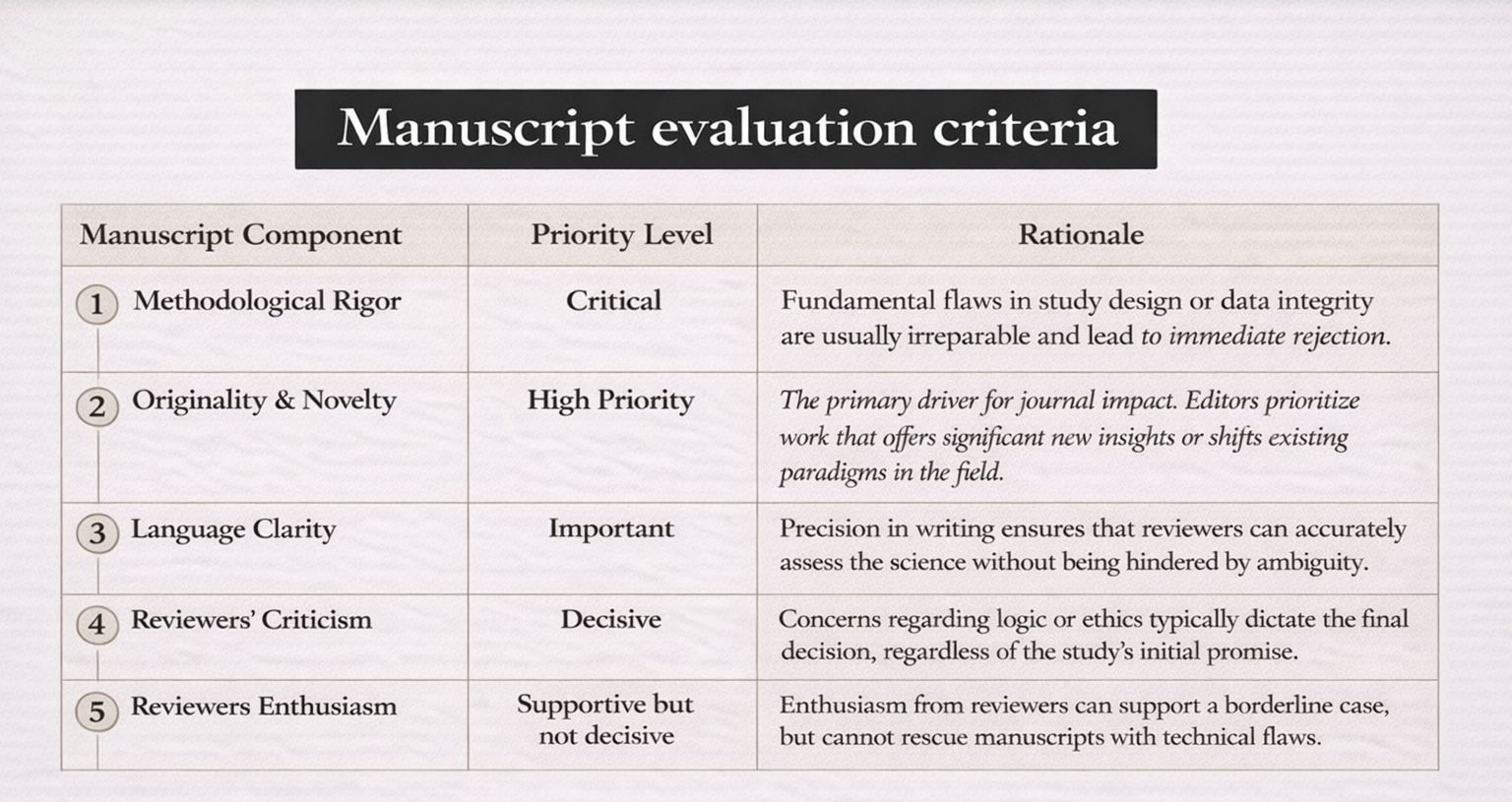
Here is the hierarchy of priorities that generally guide our publishing decisions:
After acceptance: what authors should do next
After all the hard work, the email every author wants to read may finally arrive: the acceptance of the manuscript. My job as a handling editor ends there, and the paper is forwarded to the production team for further processing.
However, your work is not quite done. During the proofreading stage, always check the text alignment and do a detailed review of the headings and image legends. Supplementary material is often left out. Thus, it is crucial you do a thorough check yourself. Also, pay close attention to your image resolution to ensure your data is presented perfectly in the final publication. Finally, don’t forget to check for extra or missing punctuation and ensure you proofread the final version of the manuscript.
Summary
Maintaining balance between authors and reviewers is challenging, but we try our best. Ultimately, manuscripts are accepted (or rejected) based on merit, and have very little to do with authors’ credentials, publication history, and familiarity. Rest assured, if the science is rigorous and aligned with journal’s scope, publishing your work is in the journal’s best interest.
Next time you open a decision letter, remember that there is a real person on the other side who worked hard and probably fought for your paper more than you realize. If and when you feel we (the editors) missed something crucial … appeal.
About the author: Sraboni Chaudhary (PhD) works at the University of Michigan and has written this article for SciManuscript. This perspective comes from her experience as a member of the editorial board of multiple mid-tier journals.
Connect with SciManuscript: X: https://x.com/scimanuscript
LinkedIn: https://www.linkedin.com/company/scimanuscript-pty-ltd